

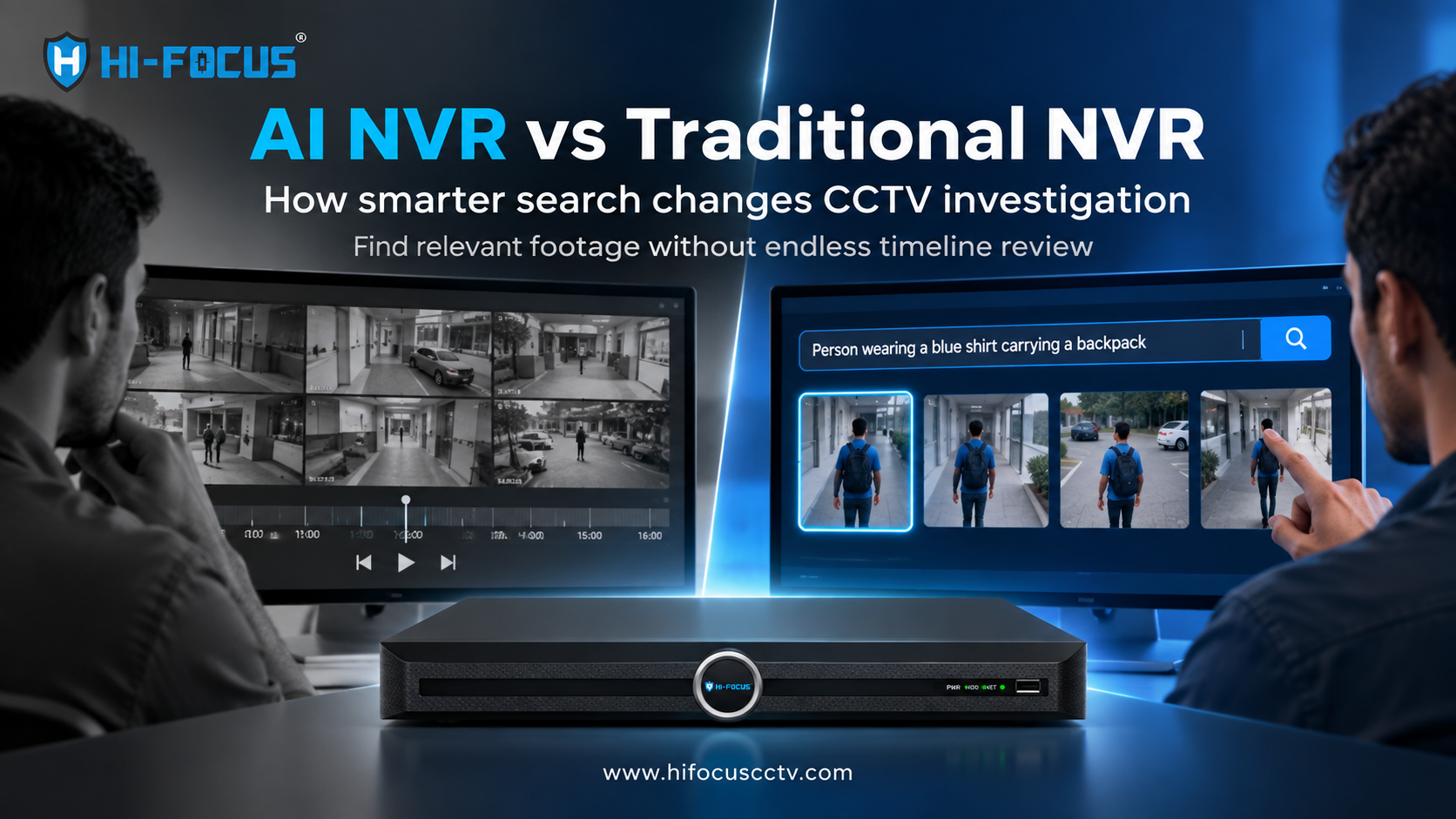
A CCTV system can record thousands of hours without telling an operator where the important moment is. Traditional NVRs rely mainly on timelines, channels, events, and predefined filters. An AI NVR can add video understanding, while natural-language video search lets investigators describe what they remember instead of reconstructing the incident through multiple menus.
Key Takeaways
A traditional NVR primarily records, stores,s and retrieves IP camera footage using time, event,nt and predefined search filters.
An AI NVR can add functions such as human and vehicle classification, face search, perimeter analytics, and video-content search.
Natural-language video search changes investigation from selecting fixed attributes to describing an object, person, or event in ordinary language.
The biggest benefit appears when footage spans many cameras or long recording periods, because investigators can narrow a search without manually reviewing every channel.
AI search does not replace human investigation. Search results still need to be reviewed, verified,d and preserved as evidence.
What Is the Difference Between an AI NVR and a Traditional NVR?
The main difference is how the recorded footage can be understood and searched. A traditional NVR generally gives operators recording, playback, timeline,ne and event-based search, while an AI NVR can analyse video for objects, people, vehicles, and other defined characteristics.
With natural-language video search, the workflow can move another step forward: instead of selecting filters such as “person + red shirt,” an investigator can enter a description such as “person wearing a red shirt carrying a black backpack.”
What Does a Traditional NVR Do?
A traditional NVR records and stores video from IP cameras and provides tools for playback, backup, and event investigation. Depending on the model, searches can include time, event, tag, motion, or predefined smart-search parameters.
For example, a conventional investigation might look like this:
Incident reported → identify camera → estimate time → open timeline → review footage → repeat across cameras.
ONVIF Profile G also defines standard functions around recording, retrieval, and playback for compatible IP video systems, including the ability to work with recorded video and metadata.
The limitation is not recording capacity. It is the amount of human effort required to locate the relevant moment.
How Does an AI NVR Change CCTV Investigation?
An AI NVR adds video analytics directly to the recording environment, allowing you to search footage by visual characteristics and events rather than only timestamps.
For example, the HiFocus NVR range includes AI models supporting functions such as face detection, perimeter events, human/vehicle classification,n and smart search. Its 40-channel HD-NVR-7240I also lists VCA search capabilities including human search and face search.
This creates a different investigation workflow:
Incident reported → describe what is known → AI narrows matching footage → operator reviews results → export evidence.
The distinction matters because the investigator does not always know the exact time of an incident. They may remember only that a person in a particular type of clothing entered an area or that a specific vehicle appeared near a gate.
CHECK OUT: AI NVR EXPLAINED
What Is Natural-Language Video Search?
Natural-language video search allows an operator to describe the visual information they are looking for using ordinary words instead of relying only on predefined filters.
Modern free-text search systems can convert both a text query and visual information from recorded footage into numerical representations and compare them for relevance. Axis describes this approach in its 2026 technical documentation for free-text forensic search.
A query could be as simple as:
“Person wearing a blue shirt carrying a backpack.”
Or:
“Black SUV near the entrance.”
The system then presents potentially relevant results for human verification.
Why Is This Different From Smart Search?
Traditional smart search generally depends on attributes that the system already knows how to classify. Natural-language search can create a more flexible query by combining descriptive concepts in a single sentence.
That distinction is important. A predefined filter asks, “Which available attributes should I select?” Natural-language search asks, “How would I describe what I saw?”
AI NVR vs Traditional NVR: What Changes?
Investigation factor | Traditional NVR | AI NVR with natural-language search |
Primary search method | Timeline, time, event | AI-assisted visual and natural-language search |
Search knowledge required | Operator needs to know available filters | Operator can describe the target |
Multiple visual attributes | Usually filter-dependent | Can be combined in a description |
Large footage volumes | More manual review | Can narrow candidate footage faster |
Unknown incident time | Difficult | Search can start from visual description |
Human verification | Required | Required |
Best use | Recording and conventional playback | Recording plus intelligent investigation |
How Much Footage Can Become Difficult to Investigate?
Consider a 40-camera site where every camera records continuously for eight hours.
40 cameras × 8 hours = 320 camera-hours of footage.
If an incident happened somewhere on the premises during that period, manually reviewing every camera could become a substantial task. AI-assisted search does not eliminate the footage, but it can reduce the initial search space by identifying candidate clips or frames.
This is one of the less obvious advantages of AI search: its value increases with investigation complexity, not simply with camera count.
A 4-camera site with a known incident time may not need advanced search. A 40-camera warehouse where nobody knows which entrance was involved can benefit much more from intelligent search.
Can an AI NVR Search Existing Recorded Footage?
Yes, depending on the AI NVR architecture and its supported search capabilities. Some systems generate metadata during recording, while other systems can analyse stored footage during or after recording.
HiFocus's IntelliSeek technology is designed around this second layer of investigation, allowing operators to enter natural-language descriptions and receive ranked results from recorded footage. HiFocus states that IntelliSeek is built into its AI NVR architecture rather than requiring a separate cloud service.
For organisations evaluating an upgrade, the important question is therefore not simply “Does the NVR have AI?” Ask: “What can I search for after the incident?”
What Should Businesses Check Before Choosing an AI NVR?
Businesses should evaluate five practical areas: supported camera channels, AI processing capacity, search capabilities, storage architecture, and camera compatibility.
For example, the HiFocus HD-NVR-7240ILM supports up to 40 channels with HiFocus AI cameras, while its published IntelliSeek information describes support for up to eight third-party ONVIF or RTSP cameras for AI search.
You should also check compatibility at the feature level. ONVIF helps standardise IP video interoperability, but interoperability does not automatically mean that every proprietary AI search feature will work identically across third-party cameras.
If you are planning an AI CCTV upgrade, review the HiFocus network video recorder range to compare channel capacities, storage options and available intelligence features before finalising the recorder.
Where Does Natural-Language Search Fit Into CCTV Security?
Natural-language search is particularly useful for post-event investigation, when the operator has a description but does not know the exact timestamp or camera.
A retail business could search for a person carrying a particular item. A warehouse could investigate a vehicle near a loading area. A factory could look for a worker without required protective equipment. These searches can reduce the time spent moving manually through unrelated footage, while the final result still requires human verification.
HiFocus and AI-Powered CCTV Investigation
As the leading Indian CCTV Brand, HiFocus develops IP surveillance, NVR, and AI-enabled security solutions for business and institutional deployments in India. Its NVR portfolio ranges from 8-channel systems to higher-capacity recorders, while selected AI NVRs add intelligent analytics and search capabilities.
Its IntelliSeek technology extends this approach toward natural-language investigation, with the HD-NVR-7240ILM positioned as the AI NVR platform for the feature. For organisations assessing AI search, the practical starting point is to map the required cameras, channels and investigation scenarios against the supported NVR and camera combination.
Conclusion
The difference between a traditional NVR and an AI NVR is increasingly about what happens after the recording is complete.
A traditional NVR provides the foundation for recording, storage, and playback. An AI NVR can add video understanding, while natural-language search changes the investigator's starting point from a timeline or predefined filter to a description of what they are looking for.
For businesses with large camera networks, the useful question is not simply how much footage the system can store. It is how quickly the right footage can be found, verified, edited, and turned into actionable evidence.
Frequently Asked Questions
1. What is an AI NVR?
An AI NVR is a network video recorder that adds artificial intelligence-based video analytics to conventional recording and playback. Depending on the model, it can support functions such as object classification, face detection, perimeter analytics, and intelligent search.
2. What is the difference between an AI NVR and a normal NVR?
A normal NVR primarily records, stores, and retrieves IP camera footage. An AI NVR adds video-analysis capabilities that can help identify people, vehicles, events,s or other visual characteristics.
3. What is natural-language video search?
Natural-language video search allows an operator to describe the footage they want using ordinary language. The AI then compares the description with visual information extracted from recorded video to identify potentially relevant results.
4. Can an AI NVR search CCTV footage by description?
Yes, if the NVR specifically supports natural-language or free-text video search. The exact search capability depends on the NVR, cameras, AI engine,ne and supported analytics.
5. Does natural-language search replace CCTV operators?
No. AI search helps locate potentially relevant footage, but an operator still needs to verify whether the result actually matches the incident and preserve appropriate evidence.
6. Can an AI NVR search footage from multiple cameras?
Some AI NVR and video-management systems can search across multiple cameras. The supported number of cameras depends on the hardware, AI workload, and specific search function.
7. Does an AI NVR require AI cameras?
Not always. Some AI functions can be performed by the NVR itself, while other analytics may be generated by the camera. Compatibility and supported AI channels should be checked before deployment.
8. Is an AI NVR useful if the incident time is unknown?
Yes. Intelligent search can be particularly useful when the exact time or camera is unknown because an investigator can begin with characteristics of the person, vehicle, or event instead of manually checking every timeline.
9. Does natural-language CCTV search work with third-party cameras?
It can, but support varies by system. ONVIF or RTSP compatibility can provide video connectivity, but proprietary AI search functions may have additional camera and channel requirements.
10. Is an AI NVR better than a traditional NVR for every business?
Not necessarily. A traditional NVR may be sufficient for smaller installations with straightforward recording and playback requirements. AI search becomes more relevant when organisations need faster investigation across larger or more complex camera networks.