As surveillance standards continue to evolve across India, government departments and public infrastructure projects are increasingly adopting security solutions that comply with the requirements set by the Standardisation Testing and Quality Certification (STQC) Directorate.
Among various surveillance technologies, IP cameras play a crucial role due to their network-based architecture, high-definition imaging capabilities, and support for advanced AI-powered analytics. STQC certification helps ensure that these products meet specific quality, cybersecurity, and performance benchmarks required for deployment across government and critical infrastructure projects.
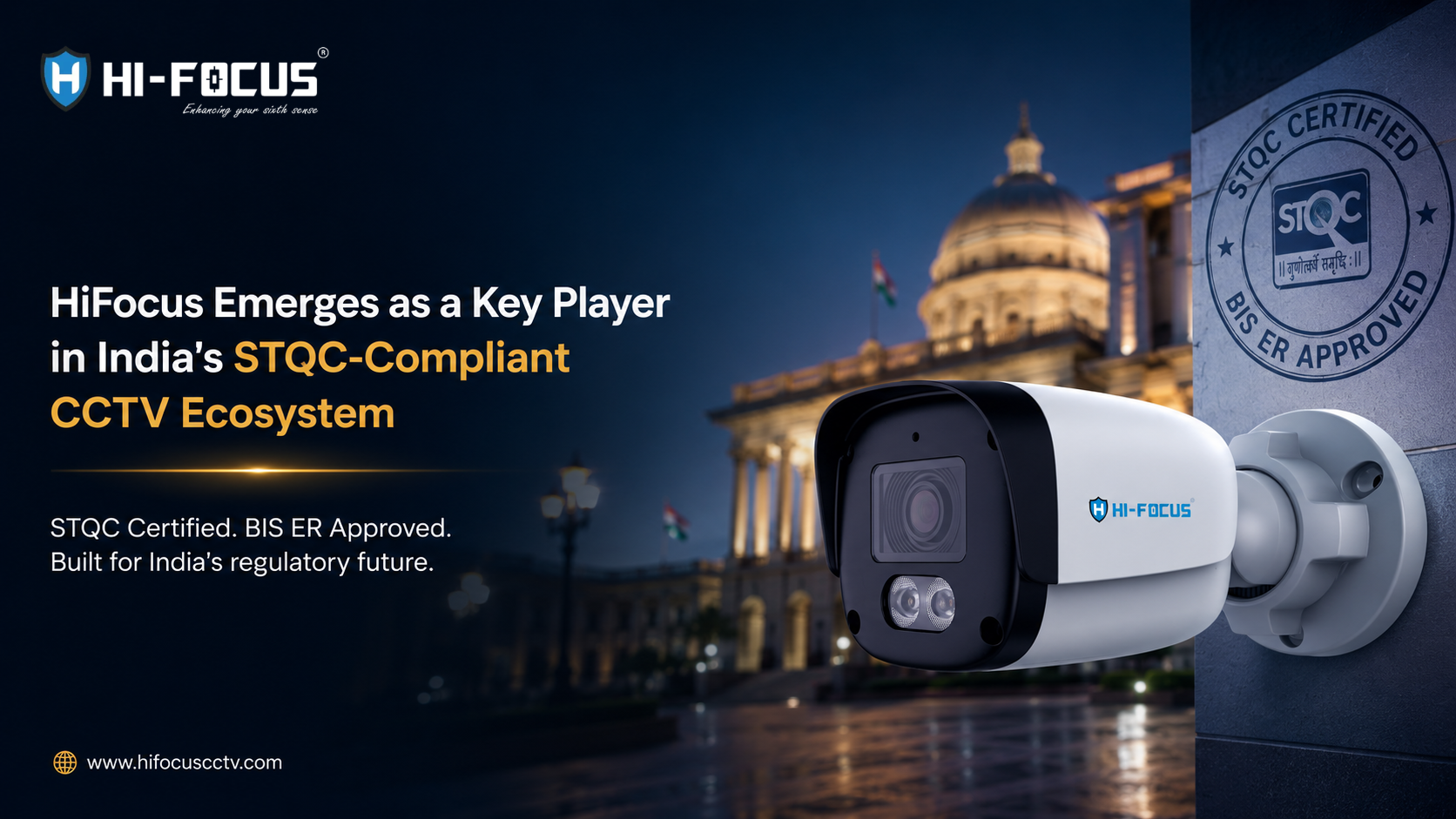
HiFocus currently has 30 STQC-approved IP camera SKUs, reflecting its focus on delivering compliant IP surveillance solutions for large-scale security deployments.
What STQC Certification Actually Means
STQC stands for Standardisation Testing and Quality Certification, a directorate under the Ministry of Electronics and Information Technology, Government of India. It tests electronic and IT products against defined benchmarks covering performance, cybersecurity, firmware integrity, hardware reliability, and environmental tolerance.
Critically, STQC certification is not self-declared. Products go through independent testing at government-recognized laboratories. Only those that pass defined thresholds receive approval. This distinction matters enormously in a market where unverified products have historically been sold with inflated spec sheets and no accountability.
Why This Matters Right Now
Smart city programs, public safety infrastructure, government campus monitoring, transport network surveillance, and defence-adjacent deployments all specify STQC-certified products in their tenders. Brands without certification are simply excluded from these opportunities regardless of how competitive their pricing or specifications might be.
The same shift is happening in the private sector. Large enterprises, hospital networks, educational institutions, and industrial groups increasingly require certified products as a vendor evaluation criterion, driven partly by insurance requirements, partly by internal IT security policies, and partly by lessons learned from deploying uncertified products that failed under
Recommending a non-certified brand on a regulated project now creates liability that most professional integrators are not willing to accept. Certification portfolio has become a shortlisting criterion before product selection even begins.
STQC-Certified IP Camera Portfolio
It is important to note that the STQC certification discussed here applies specifically to the HiFocus IP Camera range and not to other camera categories.
The approved portfolio includes multiple IP surveillance models designed for different deployment scenarios, including:
Bullet IP Cameras for perimeter and boundary monitoring.
Dome IP Cameras for offices, institutions, commercial buildings, and indoor public spaces.
AI-enabled IP Camera Series equipped with intelligent video analytics for enhanced situational awareness.
With a portfolio of 30 STQC-approved SKUs, these solutions can support a wide range of surveillance requirements across government and institutional projects.
Typical Applications of STQC-Certified IP Cameras
STQC-compliant IP cameras are commonly considered for deployments across various public and institutional environments, including:
Government offices and administrative buildings
Smart City surveillance infrastructure
Educational institutions and universities
Healthcare facilities and hospitals
Public transportation hubs
Municipal projects
Critical infrastructure and utility installations
The Core Product Range of HiFocus
IP Cameras
The IP camera range forms the core of the STQC-certified portfolio. Covering resolutions from 2MP to 8MP, in bullet, dome, vandal-resistant, explosion-proof, fisheye, and solar-powered variants, the range is built to address deployments from a small commercial office to a multi-site enterprise network or a government campus. All models in this range carry HIT Technology cybersecurity at the firmware level, which directly addresses the security compliance dimension of STQC requirements.
HD CCTV Cameras
The HD CCTV camera range extends certified coverage to analog HD deployments, which remain relevant for organizations with existing DVR infrastructure or mixed analog-IP environments. For buyers not yet ready to migrate fully to IP, having STQC-certified HD cameras available means they can maintain compliance even during a phased transition.
Network PTZ Cameras
Network PTZ cameras bring certified long-range and wide-area coverage to the portfolio, relevant for perimeter monitoring of large campuses, industrial plants, and public spaces where fixed cameras cannot provide adequate coverage without significant multiplication of units.
NVRs and HVRs
On the recording side, HiFocus high-performance NVR systems complete the IP surveillance ecosystem. Ranging from 8 to 160 channels with multi-SATA storage bays, 4K recording capability, and AI-powered detection features including face recognition, perimeter intrusion, and vehicle detection, these recorders are built for deployments that require long retention periods and intelligent footage management. For organisations managing existing analog infrastructure alongside new IP cameras, the hybrid video recorder range provides an XVR-based bridge that supports both signal types under one management interface, making phased migrations practical rather than disruptive.
Smart WiFi CCTV Cameras
Even the smart WiFi camera range, primarily aimed at smaller commercial and residential deployments, sits within a brand framework that now carries verified regulatory standing, which matters for buyers who want consistency across a multi-site deployment that mixes installation types.
Cybersecurity as a Certification Pillar
One of the dimensions most buyers underestimate when evaluating STQC compliance is cybersecurity. STQC testing for IP surveillance products includes firmware integrity verification, authentication controls, and communication security. Passing these tests requires more than adequate hardware. It requires a security architecture that holds up under independent examination.
This is where HIT Technology, HiFocus's HIFOCUS Integrated Trust framework, becomes directly relevant to the certification story. HIT Technology governs device integrity through cryptographic firmware validation, secure boot that verifies system state at every power-on, encrypted and authenticated communication between cameras and NVRs, controlled update pathways that prevent installation of unverified firmware, and access controls that prevent unauthorized configuration changes.
What This Means for Different Buyers
For government and PSU procurement teams
STQC certification removes the compliance risk that comes with specifying uncertified products. HiFocus now qualifies for smart city tenders, educational institution projects, healthcare facility deployments, transport network surveillance, and public infrastructure programs where STQC compliance is a mandatory eligibility criterion.
For enterprise buyers and corporate security teams
The certification provides third-party verification of product quality that internal procurement governance increasingly requires. It also reduces the risk of deploying products that fail cybersecurity audits, which are becoming standard in enterprise IT security reviews.
For system integrators and channel partners
Working with a STQC-certified brand reduces liability on regulated projects and simplifies the compliance documentation process. Rather than sourcing certified cameras from one brand and recorders from another, integrators can now build complete, compliant systems from a single HiFocus product portfolio. The brand's position as one of the top Indian CCTV brands with a certified range means this advantage compounds as compliance requirements tighten further.
For multi-sector deployments
The range depth is particularly relevant. A single brand covering IP cameras, HD cameras, NVRs, hybrid recorders, PTZ systems, and WiFi cameras under one certified framework means procurement, support, and compliance documentation are managed through one vendor relationship rather than several. For organisations managing security across offices, warehouses, campuses, and industrial sites simultaneously, this simplification has genuine operational value.
A Brand Built for Where India Is Going
India's surveillance market is not going to become less regulated. The trajectory is clearly toward stricter compliance requirements, greater accountability for brands and integrators, and stronger emphasis on cybersecurity in connected surveillance infrastructure.
HiFocus has spent the past several years building toward exactly this environment. The STQC and BIS ER certifications are the visible outcome of that investment, but the underlying work spans product engineering, firmware security architecture, independent testing, and the deliberate decision to build a range broad enough to serve every deployment type under one compliant brand.
If you are evaluating surveillance systems for a government project, an enterprise deployment, an industrial facility, or a multi-site organization, the HiFocus certified product range is worth a closer look. The team at the leading Indian CCTV Brand is available for project-specific consultations to help you identify the right configuration for your compliance requirements, site conditions, and budget.
Get in touch to start that conversation.
Frequently Asked Questions
Q: What is STQC certification for CCTV cameras in India?
STQC, or Standardisation Testing and Quality Certification, is a government testing framework under MeitY that independently verifies electronic products against defined standards for performance, cybersecurity, firmware integrity, and hardware reliability.
Q: Is STQC certification mandatory for CCTV cameras in India?
It is mandatory for government and PSU procurement in many tender categories. For private sector buyers, it is not legally mandatory but is increasingly required by enterprise procurement policies, insurance requirements, and project-specific compliance standards.
Q: What is BIS ER approval and how is it different from STQC certification?
BIS ER, Bureau of Indian Standards Electronics Registration, verifies electrical safety compliance and conformity to Indian product standards. It is a mandatory registration requirement before electronic surveillance products can be legally sold in India. STQC certification covers performance, cybersecurity, and quality benchmarks. Both are required for fully compliant surveillance products in the Indian market.
Q: Which HiFocus products are STQC certified?
HiFocus holds STQC certification across its IP camera range, HD CCTV cameras, network PTZ cameras, and associated recording systems. The certification spans multiple product categories rather than a single flagship model, making it possible to build complete, compliant surveillance systems from one brand.
Q: Why does cybersecurity matter for STQC compliance in CCTV cameras?
STQC testing for IP surveillance products includes firmware integrity verification, authentication controls, and communication security. HiFocus's HIT Technology cybersecurity framework, which covers secure boot, encrypted communication, and controlled update governance, directly supports the cybersecurity components of STQC compliance rather than being a separate feature.
Q: Can system integrators specify HiFocus cameras for government projects?
Yes. With STQC certification and BIS ER approval, HiFocus cameras meet the compliance criteria specified in government and PSU procurement tenders for surveillance equipment. Integrators can contact HiFocus directly for compliance documentation required during the tender submission process.
Conclusion
As security infrastructure across India becomes increasingly technology-driven, compliance standards such as STQC are playing an important role in product selection for government and public sector projects.
With 30 approved STQC-certified IP camera models, HiFocus contributes to this evolving ecosystem by offering IP surveillance solutions designed to align with current quality and performance requirements. The focus remains on delivering compliant IP-based surveillance systems suitable for a variety of institutional and infrastructure applications.