Installing Series: This article is Part 2 of HiFocus's Installing Series, a knowledge guide designed to help security planners, school administrators, college facility managers, and system integrators make informed decisions about surveillance placement across different environments.
Read Part 1: Most Important Places to Install CCTV Cameras in Hospitals.
CCTV cameras in schools and colleges serve a purpose that goes well beyond basic crime prevention. They support discipline, protect staff and students, provide evidence during disputes, and are increasingly mandated by state and central authorities in India as part of safe campus standards.
This guide walks through every important area where CCTV cameras should be installed in schools and colleges in India, why each location matters, and what type of camera is best suited for each zone.
Why Educational Institutions Need a Structured Approach to CCTV Placement
Public zones like gates, reception areas, and visitor waiting areas need visible cameras that act as a deterrent.
Semi-restricted zones like corridors, stairwells, canteens, and libraries need cameras that monitor movement and prevent incidents without disrupting the learning environment.
Restricted zones like examination halls, server rooms, and administrative offices need cameras focused on access control and integrity.
Outdoor zones like playgrounds, parking areas, and campus perimeters need weatherproof cameras with sufficient range to cover open areas.
Top 12 Key Places to Install CCTV Cameras in Schools and Colleges
1. Main Entrance and Campus Gates
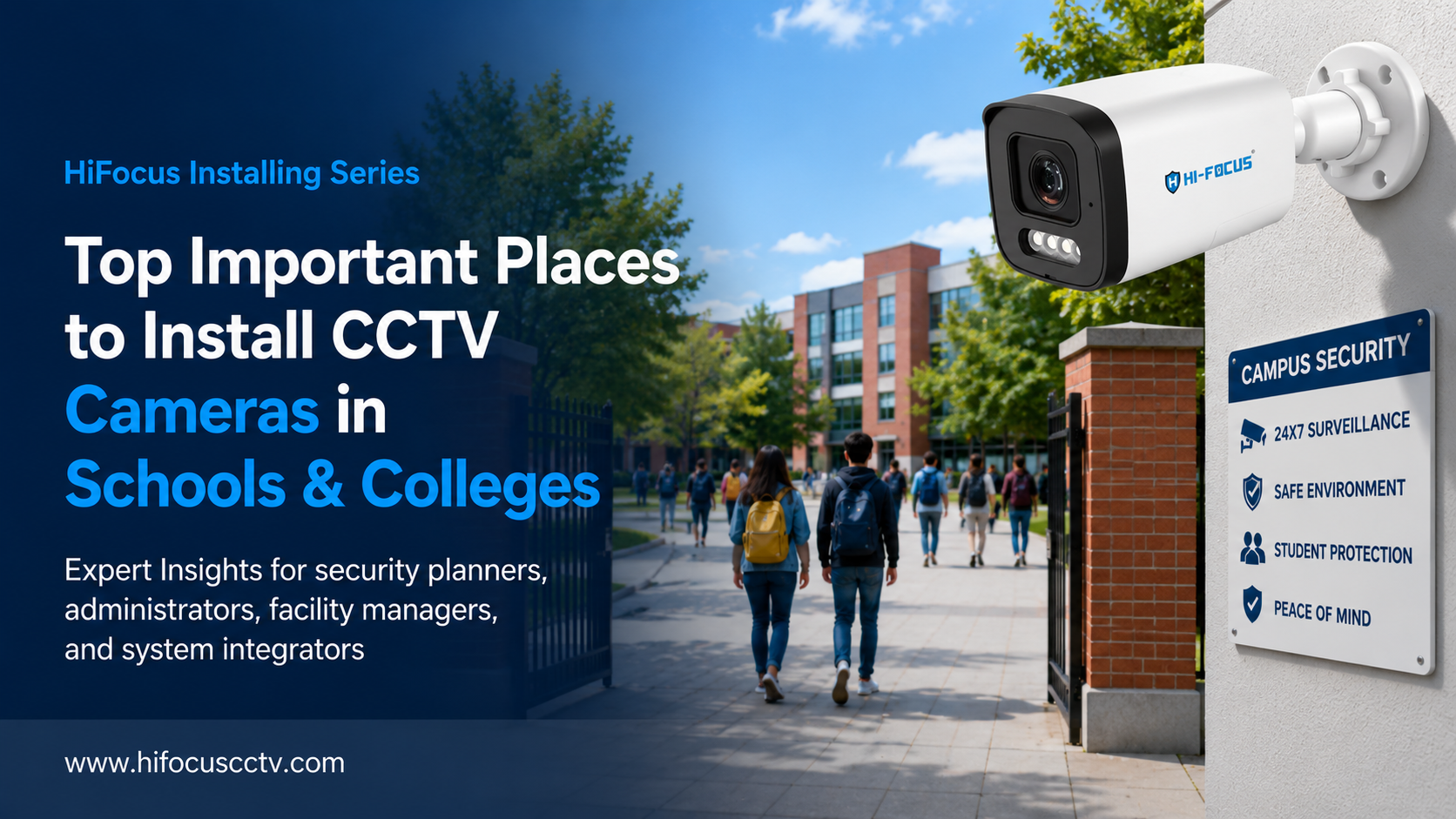
Every person entering or leaving a campus passes through the main gate. This is the most fundamental checkpoint in any educational institution's security plan, and it is the first place to invest in CCTV coverage.
Cameras at the main gate should capture clear, face-level footage of individuals entering and exiting. In schools, this is particularly important during pick-up and drop-off hours when parents, private vehicle drivers, and auto-rickshaw operators come and go in high volume. In colleges, entrance cameras also help track the movement of outsiders who are not students or staff.
Camera recommendation: A 5MP vandal dome motorized varifocal network camera works well at gates where the distance to subjects can vary. For wider road-facing entries, an outdoor IP bullet camera with IR night vision ensures coverage during early morning or evening hours when lighting is limited.
2. Reception and Administrative Block Entrances
In schools, this area also sees a regular flow of parents, delivery personnel, and service staff. In colleges, administrative blocks handle admissions, fee payments, and staff interactions where disputes or complaints can arise. Having clear footage of these interactions provides a neutral record that resolves most disputes quickly.
Camera recommendation: A fixed IP dome camera with 4MP or 5MP resolution works well for indoor reception areas. Positioning matters: the camera should capture faces at the entry point, not just overhead movement.
3. Classrooms Entry Points and Exam Halls
Cameras inside classrooms are a sensitive and frequently debated topic. The right approach for most schools is to cover the entry and exit points of classrooms, not the classroom interiors themselves. This tells you who entered a particular classroom and when, which is useful for attendance disputes, incident investigations, and unauthorised access situations.
Examination halls, however, are a different matter. Here, cameras inside the hall are not just acceptable, they are increasingly required. The CBSE and many state boards now mandate functional CCTV coverage in examination centres to prevent malpractice. Cameras should cover all rows of seating without blind spots, with at least one camera covering the invigilator's desk as well.
Footage from examination halls must be stored for a defined retention period as per board guidelines and must be accessible to the institution's examination committee and, where required, the board's inspection team.
Camera recommendation: For exam halls, wide-angle dome cameras with 4MP or 5MP resolution that cover the full room in as few mounting points as possible are the practical choice. For large halls, fisheye or panoramic IP cameras reduce the number of cameras needed while maintaining complete coverage.
4. Corridors and Stairwells
Corridors are where most in-campus incidents actually happen between classes, during breaks, and at the start and end of the school day. Stairwells are natural blind spots, and in large multi-storey buildings, they are often where incidents go unrecorded simply because cameras were never placed there.
Stairwells should have at least one camera per landing, positioned to cover the stairs in both directions.
Camera recommendation: Corridor-mode IP cameras from the HiFocus IP camera range are well suited for school and college passages. For stairwells, a compact dome camera at each landing ensures complete coverage without requiring complex cabling.
5. Canteen and Common Areas
The school or college canteen is a high-footfall area with a relatively unstructured environment during break times. It's where food-related complaints, minor altercations, and theft of personal belongings tend to occur. Common areas like seating courts, covered walkways, and student lounges in colleges carry similar risks.
Cameras in these areas are not about monitoring individual behaviour, they're about having a record when something goes wrong. A fight that starts in the canteen and spills into a corridor, or a theft from a bag left unattended at a table, is far easier to investigate with footage than without.
Camera recommendation: Wide-angle dome cameras with good low-light performance work well in canteens, which often have mixed lighting across different times of day. For larger college common areas, a PTZ camera or multiple fixed dome cameras provide the coverage depth these spaces need.
6. Library
Theft of library materials, misuse of computer terminals, and unauthorised access to restricted sections are real concerns in large institutional libraries. Cameras should be placed at entry and exit points, at the circulation desk, near high-value or restricted shelves, and covering the computer terminal area.
Camera recommendation: Small, discreet indoor dome cameras with 2MP or 4MP resolution work well in libraries. The camera housing should be unobtrusive to preserve the environment of the space.
7. Laboratories Science, Computer, and Vocational
School and college laboratories hold expensive equipment computers, scientific instruments, chemicals, and electronic components. They are also areas where safety incidents like fires, chemical spills, or equipment damage need to be recorded for insurance and liability purposes.
Computer labs in particular see significant misuse when not supervised students accessing restricted content, damaging hardware, or using equipment outside permitted hours. A camera covering the lab from the front of the room, positioned to capture screens and user activity at a general level, acts as a strong deterrent without being invasive.
Science and chemistry labs should also have cameras covering chemical storage cabinets and the areas around fume hoods and safety equipment, where misuse could pose a genuine safety risk.
Camera recommendation: Fixed 4MP or 5MP IP dome cameras covering the lab floor from an elevated front or corner mount. For computer labs, angling the camera to capture the full row of workstations from one end of the lab is the most efficient approach.
8. Sports Grounds and Open Outdoor Areas
Playgrounds, sports fields, basketball courts, and open outdoor spaces are often left without any camera coverage simply because they are large. But these spaces see incidents of student altercations, trespassing from outside the campus perimeter, theft of sports equipment, and accidents during unsupervised hours that would benefit from recorded footage.
Outdoor camera placement for large open areas needs cameras with sufficient IR range, wide-angle lenses, and weatherproofing for year-round operation in Indian conditions. A single well-placed PTZ camera can cover a large playing field, or multiple bullet cameras with wide fields of view can be used at boundary positions.
Camera recommendation: Outdoor IP bullet cameras with long IR range for boundary walls and fixed perimeter positions. For larger open grounds, a network PTZ camera covering the full field from an elevated mount is more effective than multiple fixed cameras.
9. Parking Areas
School and college parking areas for staff vehicles, student two-wheelers, and visitor cars are consistently undermonitored. Vehicle theft, damage to parked vehicles, and altercations in parking lots are common and are almost always investigated after the fact, when footage would have been the only evidence.
Camera recommendation: Outdoor IP bullet cameras with wide-angle lenses and strong IR performance for open parking areas. For covered or basement parking, Dark Hunter full-colour low-light cameras are particularly effective since they capture clear colour footage in near-zero ambient light without switching to black-and-white infrared mode.
10. Hostel Premises Entry Points, Corridors, and Common Rooms
Hostels on college campuses require careful and well-planned CCTV coverage because they are residential environments. Cameras should never be placed inside rooms or bathrooms but the entry points, corridors, common rooms, and warden offices should all have coverage.
The hostel main gate needs a camera covering entry and exit at all hours, since late-night returns are a common concern. Common rooms and TV rooms, where most group incidents happen, should have a camera covering the room from an elevated position.
Camera recommendation: Vandal-proof IP dome cameras with IK10 housing for hostel corridors and common rooms. For hostel entry gates, cameras with night vision capability are essential since security incidents in hostels often occur during late hours.
11. Server Rooms and IT Infrastructure Areas
These areas house sensitive data: student records, examination data, financial information, and institutional credentials. Unauthorised access to server rooms is not just a physical security issue it is a data security event. A camera covering the entry door and the server racks provides a visual record of every access, supplementing the digital access logs that most such rooms generate.
Camera recommendation: Fixed IP dome cameras with tamper detection capability. These cameras should be connected to a dedicated NVR with role-based access controls so that only authorised personnel can review the footage.
12. Principal's Office, Staff Rooms, and Administrative Offices
Cameras at the entry points of administrative zones not inside offices, but at their doorways and corridors help track access to sensitive areas during and after working hours. These zones often hold important documents, cash from fee collections, and sensitive institutional records.
In schools, the principal's chamber and the fee collection counter are particularly important. Disputes over fee payments or admissions that escalate into complaints are much easier to resolve when the interaction was recorded.
Camera recommendation: Compact fixed IP dome cameras at doorways and corridor junctions near administrative zones. The priority is capturing who enters and exits these areas, not monitoring work activity inside.
A Note on Privacy and Compliance in Schools and Colleges
The Digital Personal Data Protection Act, 2023, applies to educational institutions that collect and store video footage of students, staff, and visitors. This means institutions must ensure that footage is stored securely, retained for defined periods, and accessible only to authorised personnel.
Mandatory signage should be displayed in all areas under CCTV surveillance. In student-facing areas, it is also good practice to include this disclosure in the institution's student handbook or code of conduct.
No cameras in private spaces, restrooms, changing rooms, medical examination areas, and the interiors of residential rooms must never have cameras installed. This is both a legal requirement and an ethical non-negotiable.
Recommended HiFocus Cameras for Schools and Colleges
Based on the specific demands of different zones, indoor classrooms, open playgrounds, exam halls, parking areas, and hostels, the following cameras from the HiFocus IP camera range are particularly well matched for school and college deployments.
Camera Model | Type | Best Suited For |
HIPC-D3315-DLS-I2 | Corridors, classrooms, canteen, reception | |
HIPC-D3024E-I2 | Libraries, labs, admin offices | |
HC-IPC-DI3215DVZK-N5-O | Exam halls, hostel corridors, staff rooms | |
HIPC-T4515-ADLS-I2 | Main gates, perimeter, outdoor areas | |
HIPC-T4024-DL-I2 | Parking areas, sports ground perimeter | |
HC-IPC-TI4315DVZK-N8-O | Hostel entry, boundary walls, basement parking | |
HIPC-D3022-DL-I2 | Common rooms, stairwells, secondary corridors |
Planning a CCTV System for Your School or College?
As a STQC-certified Indian manufacturer, HiFocus cameras also meet procurement compliance requirements for government-aided schools and colleges operating under Make in India guidelines.
If you're assessing how surveillance fits into a broader institutional security and technology infrastructure, it's also worth looking at how HiFocus solutions span across industries. The same discipline of zoned, purpose-driven placement applies whether you're running a hospital, a commercial facility, or a campus.
Explore our full range of security and surveillance solutions, browse the complete HiFocus product catalogue, or get in touch with our team to discuss your institution's specific requirements.
Frequently Asked Questions
Where should CCTV cameras be installed in a school?
CCTV cameras in schools should be installed at the main entrance and all secondary gates, reception and administrative block entries, corridor junctions, stairwells, the canteen, examination halls, laboratories, the library, parking areas, and the sports ground perimeter.
Are CCTV cameras mandatory in schools in India?
CBSE mandates functional CCTV surveillance in examination centres affiliated with the board. Several state governments have also issued directives requiring CCTV systems in schools, particularly in examination areas.
Can CCTV cameras be installed inside classrooms?
Cameras at the doorways of classrooms are generally accepted for access monitoring. Cameras inside the classroom itself are a more sensitive decision that depends on school policy, board guidelines, and parent-community agreement. For examination halls specifically, cameras inside the room are standard practice and required by most examination boards.
What type of CCTV camera is best for a college hostel?
Vandal-proof dome cameras with IK10 impact rating are best suited for hostel corridors. Entry gates need cameras with strong night vision since hostel security incidents often happen during late hours. Common rooms work well with standard fixed dome cameras.
How many cameras does a school or college need?
The number of cameras depends entirely on the size of the campus, the number of buildings, the layout of corridors and outdoor areas, and the level of coverage required. A small school might need 8 to 16 cameras, while a large residential college campus could need 64 or more. A proper site survey is the only accurate way to determine this.
What is corridor-mode CCTV and why is it useful for schools?
Corridor mode is a feature in certain IP cameras that rotates the captured image by 90 degrees, changing the standard horizontal aspect ratio to a vertical one. This makes it possible to cover the full length of a narrow corridor from a single camera mounted at one end, rather than placing multiple cameras along the wall.
Does HiFocus offer CCTV solutions specifically for schools and colleges?
Yes. HiFocus offers dedicated CCTV camera solutions for schools and colleges, including camera selection, NVR compatibility, and support for compliance with CBSE and UGC requirements.
This article is Part 2 of the HiFocus Installing Series. Part 1 covered CCTV camera placement in hospitals. Future parts will cover other sectors and environments where surveillance placement decisions are critical.