Introduction: The Illusion of “Complete Security”
For years, CCTV systems have been synonymous with safety. Businesses, homes, and public infrastructure rely heavily on surveillance to deter threats and monitor activities. But here’s the uncomfortable truth: while cameras capture everything, they don’t necessarily protect everything.
In today’s connected world, most CCTV systems are part of larger networks, linked to cloud storage, mobile apps, and remote access platforms. This connectivity brings convenience, but also opens the door to cyber risks. Without cybersecurity, even the most advanced surveillance setup can become a vulnerability instead of a safeguard.
That’s where the conversation is shifting, and why cybersecurity is no longer optional in modern CCTV systems.
The Growing Pain Points in the CCTV Industry
Despite rapid advancements in camera technology, several critical gaps still exist:
1. Vulnerability to Hacking
Many CCTV systems operate on outdated firmware or weak authentication protocols. This makes them easy targets for unauthorized access, allowing hackers to view, manipulate, or even disable footage.
2. Data Privacy Risks
Surveillance footage often contains sensitive data. Without encryption or secure storage, this data can be intercepted or leaked, raising serious privacy concerns.
3. Lack of Compliance with Standards
As governments tighten regulations, especially in countries like India, many systems fail to meet cybersecurity and compliance benchmarks, putting organizations at legal and operational risk.
4. Weak Network Integration
Modern surveillance systems are integrated with IT infrastructure. If cybersecurity isn’t built into the system, it can become an entry point for broader cyberattacks across the network.
5. False Sense of Security
Perhaps the biggest issue is that organizations assume that installing cameras equals security. In reality, without cyber protection, these systems can be exploited from within.
HIT TECHNOLOGY: Where Surveillance Meets Cybersecurity
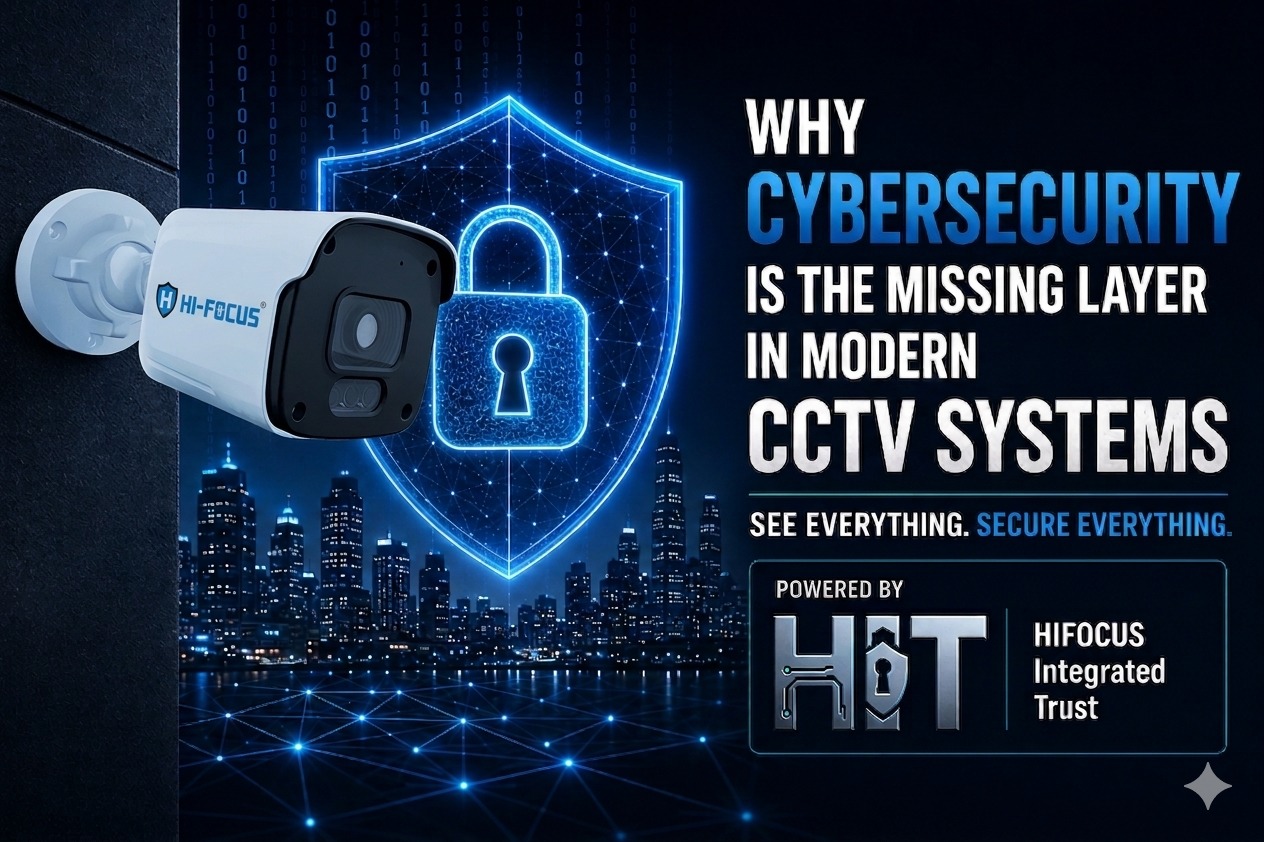
To address these challenges, HIFOCUS introduces HIT (HIFOCUS Integrated Trust), a forward-thinking approach that integrates cybersecurity directly into surveillance systems.
Rather than treating cybersecurity as an add-on, HIT builds it into the core architecture of CCTV solutions. This ensures that surveillance systems are not just watchful but also resilient, secure, and future-ready.
What Makes HIT Technology Different?
HIT is designed to bridge the critical gap between physical surveillance and digital protection. Here’s how:
End-to-End Encryption
Data captured by cameras is encrypted at every stage, from transmission to storage, minimizing the risk of interception.
Secure Remote Access
With controlled authentication and access protocols, users can monitor systems remotely without exposing them to cyber threats.
Firmware Integrity & Updates
Regular and secure firmware updates ensure systems remain protected against evolving vulnerabilities.
Network-Level Protection
HIT-enabled systems are designed to integrate securely with IT networks, reducing the risk of lateral cyberattacks.
Compliance-Ready Architecture
Built to align with national and global cybersecurity standards, making it easier for businesses to stay compliant.
Why Cybersecurity-Enabled CCTV is a Game Changer
When cybersecurity is embedded into surveillance systems, the benefits go beyond protection:
Stronger Trust: Clients, customers, and stakeholders feel more confident knowing their data is secure.
Reduced Downtime: Secure systems are less prone to disruptions caused by cyber incidents.
Future Scalability: Cybersecure systems are easier to upgrade and integrate with smart technologies like AI and IoT.
Regulatory Compliance: Avoid penalties and stay ahead of evolving security regulations.
Holistic Security: Combines physical monitoring with digital defense, closing the loop on vulnerabilities.
HIFOCUS and STQC Certification: Raising the Benchmark
A major step forward in India’s surveillance ecosystem is compliance with stringent cybersecurity standards.
Standardisation Testing and Quality Certification Directorate (STQC) certification is one such benchmark that validates the security, quality, and reliability of electronic products.
HIFOCUS has achieved STQC certification for its surveillance solutions, demonstrating its commitment to secure, compliant, and high-quality systems.
This certification is more than a badge; it signals that HIFOCUS products are built to meet India’s evolving regulatory and cybersecurity requirements. It also positions the brand as a reliable choice for government, enterprise, and large-scale deployments.
About HIFOCUS: Building the Future of Secure Surveillance
HIFOCUS is redefining surveillance in India by combining innovation with compliance. With a strong focus on quality, scalability, and now cybersecurity through HIT, the brand is enabling businesses to move beyond traditional CCTV setups.
From advanced IP cameras to intelligent monitoring systems, HIFOCUS is aligned with the future of smart, secure infrastructure.
FAQs
1. Why is cybersecurity important in CCTV systems?
Because modern CCTV systems are connected to networks and the internet, without cybersecurity, they can be hacked, leading to data breaches and operational risks.
2. What is HIT Technology by HIFOCUS?
HIT (HIFOCUS Integrated Trust) is an integrated approach that embeds cybersecurity features into surveillance systems, ensuring secure monitoring.
3. What does STQC certification mean for CCTV systems?
It ensures that the product meets strict government standards for quality, safety, and cybersecurity, making it suitable for high-trust environments.
4. Can small businesses benefit from cybersecure CCTV systems?
Absolutely. Cyber threats don’t discriminate by size. Secure systems protect both data and operations, regardless of business scale.
5. Is upgrading to a cybersecure CCTV system complicated?
Not necessarily. With solutions like HIT, cybersecurity is built into the system, simplifying deployment and management.
Conclusion: The Missing Layer Can’t Be Ignored Anymore
CCTV systems have evolved, but the threats around them have evolved faster. The gap between surveillance and cybersecurity is no longer something businesses can afford to overlook.
The future of security lies in integration, where cameras don’t just capture footage, but also protect it. With innovations like HIT Technology and compliance-driven approaches backed by STQC certification, HIFOCUS is leading this shift.
Because in today’s world, seeing is not enough; securing what you see is what truly matters.