Quick Answer: For most large businesses in India managing up to 160 cameras across one or multiple sites, a high-performance NVR system is the more practical, cost-effective, and easier-to-manage choice. A VMS makes sense when you are managing 200+ cameras across geographically spread locations and need deep third-party software integration. Read on to understand why.
Introduction
If you are responsible for security at a large office, hospital, industrial facility, or multi-branch business, you have probably run into this question: Should we go with a Network Video Recorder (NVR) or a Video Management Software (VMS) platform?
Both record and manage surveillance footage. But they are built differently, priced differently, and suited for different scales of operation. Choosing the wrong one does not just cost money; it creates complexity your team did not sign up for.
This guide breaks down the actual differences between VMS and NVR systems, explains when each one is the right fit, and helps you make a well-informed decision, without drowning in technical jargon.
What is an NVR System?
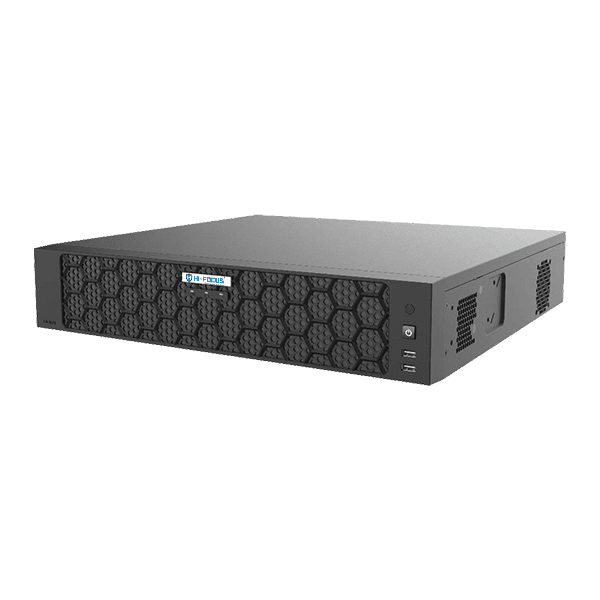
An NVR, Network Video Recorder, is a dedicated hardware device that records, stores, and manages video from IP cameras connected over a network. Think of it as the central brain of a digital CCTV setup. Cameras send their video feeds to the NVR over your LAN or PoE switch, and the NVR handles recording, storage, live viewing, and playback.
Some also include built-in AI capabilities for smart detection; these are called AI NVRs.
What Can an NVR Do?
Record continuously from multiple IP cameras simultaneously
Store footage locally on internal hard drives, typically 30 to 90 days, depending on storage configuration
Play back footage with timeline-based search and event filtering
Allow remote access via mobile app or desktop browser from anywhere
Run AI analytics on AI NVR models, face detection, intrusion alerts, vehicle detection, and smart search
Integrate with IP cameras via ONVIF or native protocols for full compatibility
What is a VMS Platform?
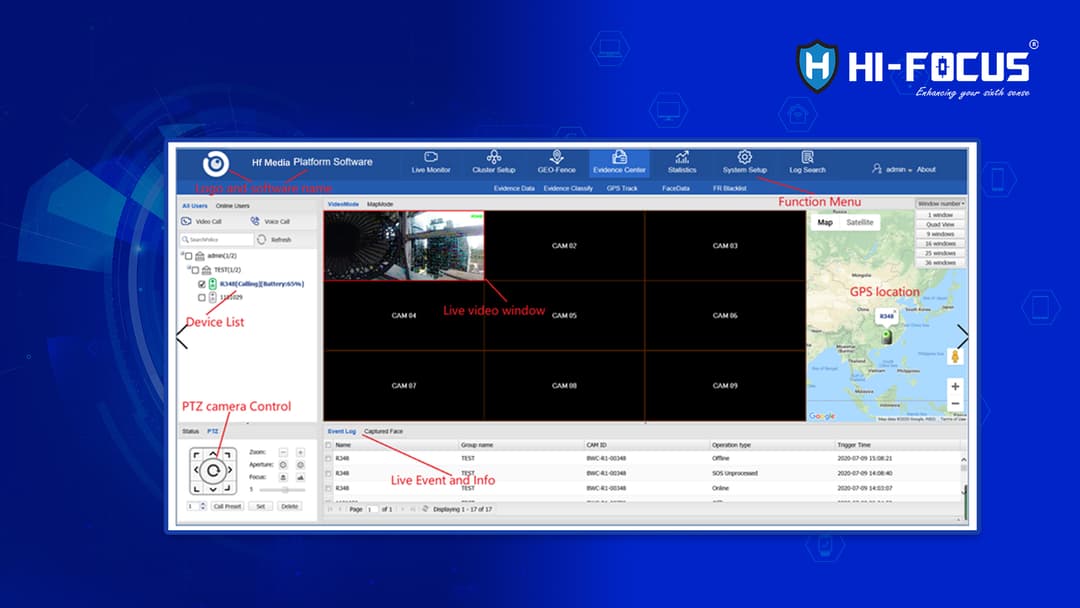
A Video Management Software (VMS) is a software application installed on a server or PC that connects to IP cameras and manages recording, playback, and monitoring from a central software interface. Unlike an NVR, VMS is not a standalone hardware device; it runs on a server you own or rent, and typically charges per camera licence on top of the hardware cost.
VMS platforms are designed for very large, complex deployments, think a national retail chain with 500 cameras across 80 stores, or a city surveillance network with centralised control for thousands of feeds. The software is powerful but requires an IT team to set it up, maintain it, and handle regular updates and licence renewals.
What Can a VMS Do?
Manage a virtually unlimited number of cameras from a single interface
Integrate with access control, fire alarms, intercoms, and other security systems
Offer advanced analytics via third-party plugin modules
Support multi-server and multi-site architectures
Provide highly customisable dashboards, user roles, and alert workflows
VMS vs NVR: The Key Differences Explained
Here is a side-by-side comparison of the two systems across the factors that matter most to large businesses:
Factor | NVR | VMS |
Best for | Single-site or multi-site up to ~160 cameras | Large multi-site, 200+ cameras |
Setup complexity | Low - plug and record | High - server, licensing, integration |
Cost | Lower upfront and running costs | Higher, especially with per-camera licensing |
AI analytics | Built-in AI NVR models | Available via third-party plugins |
Remote access | Mobile and desktop apps included | Via VMS client or web browser |
Cybersecurity | Hardware-level (e.g. HIT Technology) | Software-level, depends on the vendor |
Scalability | Up to 160 channels per unit | Virtually unlimited with server scaling |
Maintenance | Minimal — hardware focused | Ongoing — software updates, licences |
When an NVR is the Right Choice for Your Business
For the majority of large businesses in India, including manufacturers, hospitals, educational institutions, hotels, warehouses, and corporate campuses, a high-performance NVR system is the better fit. Here is why:
1. You Are Managing Up to 160 Cameras
NVR systems have grown significantly in capacity. HiFocus NVR systems scale from 8 channels to 160 channels, which covers most large enterprise deployments comfortably. A 160-channel NVR can handle a large factory floor, a multi-wing hospital, or a full commercial complex without needing a separate server room or software licences.
2. You Want a Simple, Reliable System
VMS is powerful, but it is also complex. It needs a dedicated Windows or Linux server, an IT team for maintenance, regular software updates, and per-camera licensing that adds up quickly. An NVR is self-contained. It records, stores, and serves footage with minimal configuration and virtually no ongoing software cost beyond storage management.
For security teams that are not full-time IT professionals, this simplicity matters a lot in day-to-day operations.
3. You Need AI Analytics Without Extra Infrastructure
Adding AI analytics to a VMS usually means a third-party plugin, additional licensing, and more server resources. With an AI NVR, the intelligence is built directly into the recorder hardware. Features like face detection, perimeter intrusion alerts, vehicle detection, and metadata-driven smart search work out of the box, no extra server, no extra cost.
4. Cost Efficiency Matters
VMS licensing can be expensive. Per-camera licensing fees of Rs. 3,000 to Rs. 15,000 per camera per year are common with enterprise VMS platforms. For a 100-camera deployment, that is a high recurring cost even before you account for the server hardware. An NVR system has a one-time hardware cost with no recurring software licence fees.
5. You Are Running a Hybrid Camera Setup
If your existing infrastructure includes a mix of older analogue cameras and newer IP cameras, Hybrid Video Recorders offer an NVR-like approach that supports both, letting you migrate gradually to a full IP setup without replacing everything at once.
When a VMS Makes More Sense for Your Business
There are scenarios where a VMS is genuinely the better tool. Be honest about whether your deployment actually needs it:
Camera count exceeds 200+: At very large scales, think airport security, smart city command centres, or national retail chains, a VMS with multiple servers and centralised management becomes more manageable than deploying and coordinating dozens of individual NVR units.
Deep integration is required: If your surveillance system needs to talk to access control hardware, fire alarm systems, visitor management software, and ERP platforms in a unified interface, a VMS gives you that flexibility.
You have a dedicated IT team: VMS requires ongoing maintenance, patching, and configuration. If you have IT staff who are comfortable managing server infrastructure, the added complexity is manageable.
You need highly customised workflows: VMS platforms allow very detailed configuration of alert rules, user permissions, automated responses, and reporting. For large operations with complex security protocols, this level of customisation can justify the cost.
Cybersecurity: A Factor You Cannot Ignore in Either System
Whether you choose an NVR or a VMS, cybersecurity is not optional anymore. Connected surveillance systems are increasingly targeted by attackers, not just to steal footage, but to use cameras as entry points into your broader corporate network.
HiFocus addresses this with HIT Technology, a multi-layered cybersecurity framework built into its NVR and IP camera products. HIT includes Secure Boot Technology (which ensures only verified firmware runs at startup), encrypted device communication, strict authentication controls, and governed firmware update processes. This hardware-level security architecture makes HiFocus NVR systems inherently more resilient than software-only VMS solutions, where security depends entirely on how well the server is configured and patched.
For businesses operating in regulated sectors, such as banking, healthcare, and government, this matters beyond just security. It matters for compliance.
Compliance in India: STQC and BIS ER Certification
If your organisation is a government body, PSU, or institution that participates in public tenders, the certification of your surveillance hardware is not just a preference, it is often a requirement.
HiFocus holds both STQC Certification and BIS ER Approval, making its NVR systems eligible for government and institutional procurement across India. Learn more about HiFocus STQC and BIS ER certification.
Most VMS platforms do not carry Indian government certifications for their software, and the hardware used with them may or may not be certified. When compliance is a decision factor, NVR systems from a certified Indian manufacturer give you a cleaner procurement path.
The Role of IP Cameras in Your NVR or VMS Setup
Regardless of which management system you choose, the quality of your IP cameras determines the quality of your footage. NVR systems are purpose-built for IP camera networks, and HiFocus NVRs are fully validated with HiFocus IP cameras for seamless compatibility — including AI analytics, two-way audio, and smart alerts.
When using a VMS, camera compatibility can become a headache. Most VMS platforms support ONVIF cameras in principle, but advanced features — particularly AI analytics and event-based recording modes- often require the same vendor's hardware to function properly. This limits flexibility and increases cost.
With an NVR approach, you get a purpose-matched ecosystem from day one.
Which Sectors Are Choosing NVR Over VMS in India?
Across the surveillance solutions that HiFocus has deployed in India, NVR systems consistently outperform VMS in adoption across the following sectors:
Manufacturing and Industrial: High camera counts, wide areas, shift-based monitoring, and perimeter security, all well within NVR range.
Healthcare: Hospitals need a reliable 24/7 recording with fast playback search. AI NVRs with smart detection help manage patient flow and restricted-area access without complex VMS setups.
Education: Schools and universities typically deploy 50 to 120 cameras. An NVR handles this comfortably with central management and remote access for administration.
Retail and Warehousing: Multiple branches with 20 to 60 cameras each work well with per-site NVR deployments managed remotely, without the overhead of a centralised VMS server.
Government and Public Infrastructure: Where STQC-certified hardware is mandatory, HiFocus NVR systems meet compliance requirements directly.
NVR or VMS? A Quick Decision Guide
Ask yourself these three questions:
Do you manage fewer than 200 cameras across your sites? NVR is likely the right fit!
Do you need deep integration with access control, fire alarms, or ERP systems in a unified platform? VMS might be worth the complexity!
Is cost efficiency, ease of operation, and compliance certification important? NVR from a certified Indian manufacturer wins clearly!
If you are coming from a legacy DVR setup and evaluating your options, you might find our article on DVR vs NVR: Key Differences Explained helpful before making your final call.
About HiFocus: A Leading CCTV Brand Built for Indian Businesses
HiFocus is one of India's most trusted surveillance brands, offering a complete range of HD CCTV cameras, IP cameras, WiFi CCTV cameras, AI NVRs, NVR systems, PTZ cameras, ANPR cameras, and network infrastructure. With STQC certification and BIS ER approval, HiFocus IP Cameras are built and tested for Indian operating conditions and backed by a pan-India support network.
For system integrators, enterprises, government bodies, and large institutions running IP camera networks, HiFocus offers a purpose-matched recording and surveillance ecosystem that works from day one, without the complexity and cost of enterprise VMS deployments.
Frequently Asked Questions
What is the main difference between VMS and NVR?
An NVR is a standalone hardware device that records and manages video from IP cameras. A VMS is software installed on a server that does the same job but at a larger scale, typically with more integration options and per-camera licensing fees. For most businesses managing up to 160 cameras, an NVR is the simpler and more cost-effective option.
Can an NVR replace a VMS for a large business?
For most large businesses in India, yes. Modern NVR systems support up to 160 channels, 4K recording, remote access, and built-in AI analytics. Unless you are managing 200+ cameras across geographically distributed locations with complex integration requirements, an NVR handles the job with less cost and complexity.
What is an AI NVR and how is it different from a standard NVR?
An AI NVR includes built-in deep learning analytics that can detect specific events in real time, such as a person crossing a boundary, vehicle detection, or face recognition, without needing a separate analytics server.
Do I need a separate server to run an NVR system?
No. An NVR is a self-contained device. Unlike a VMS, which requires a dedicated server and software installation, an NVR connects directly to your IP cameras, records to its internal storage, and provides remote access via a mobile or desktop app, no server room required.
Are HiFocus NVR systems eligible for government tenders in India?
Yes. HiFocus holds STQC Certification and BIS ER Approval, which are the standard compliance requirements for government and institutional surveillance procurement in India.
How do I choose between NVR and VMS for a multi-site business?
For multi-site businesses with up to 30 to 40 cameras per site, deploying individual NVR units at each location and accessing them remotely through a centralised app is typically the most practical approach. VMS becomes worth considering only when your total camera count exceeds 200, and you need a single software interface to manage all sites from one server.
Not Sure Which System Is Right for Your Project?
Every surveillance project is different. If you are planning a new IP camera network or upgrading an existing system, the HiFocus team can help you evaluate the right approach, NVR, AI NVR, or hybrid, based on your camera count, site layout, compliance requirements, and budget.
Contact HiFocus for a free project consultation and get recommendations from one of India's most experienced surveillance teams.